
How to Generate Content Ideas for Thought Leadership
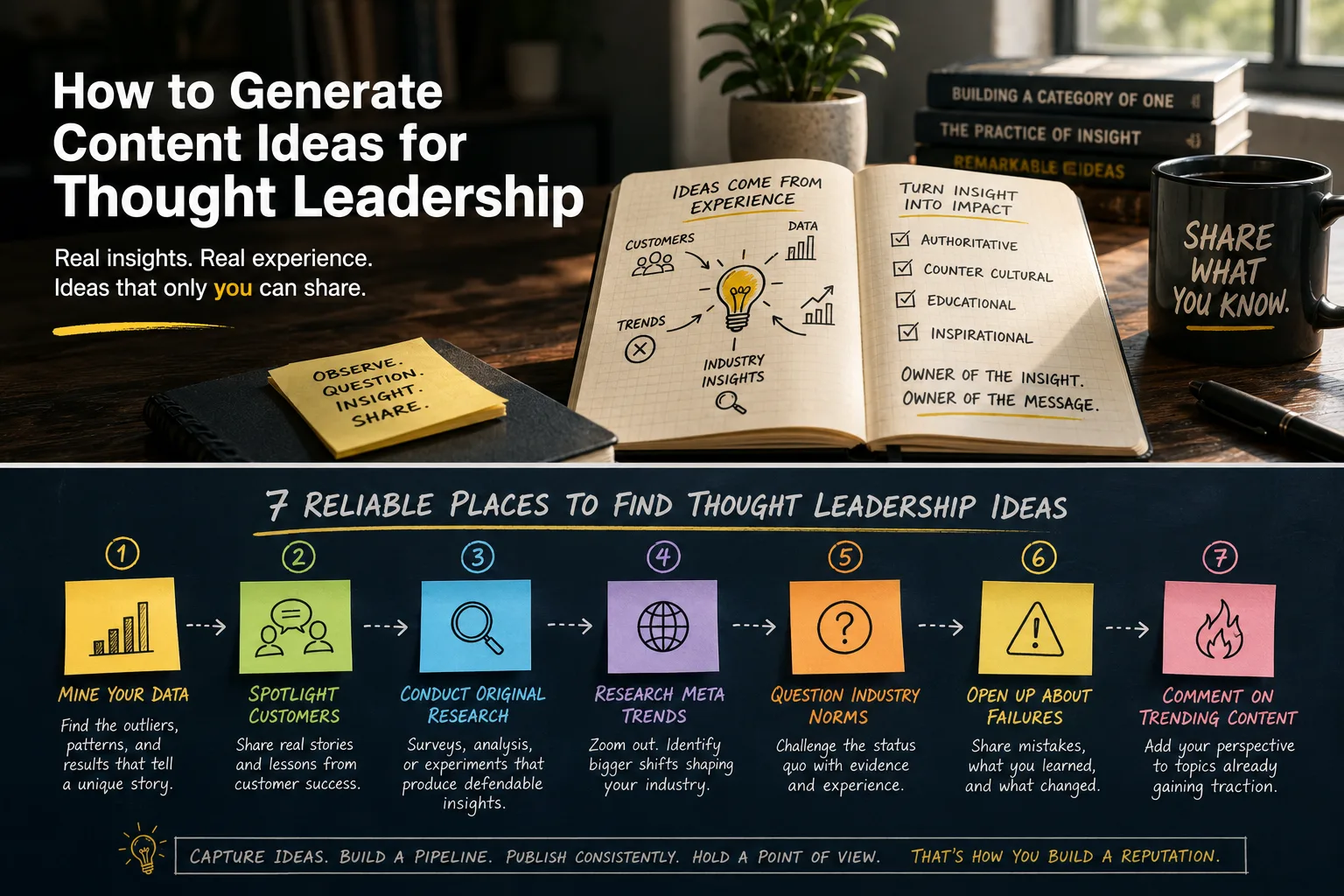
Authenticity is the currency of content marketing, and it keeps gaining value as AI takes on more of the writing that used to be done by hand. Thought leadership works because it carries something a model cannot invent: real insight drawn from real experience. That makes it a cornerstone of any serious content strategy.
Coming up with original ideas is the hard part, especially in a crowded field where the obvious angles have been covered a hundred times. If you are stuck, the good news is that inspiration is usually closer than you think. The trick is knowing which sources to check and how to turn what you find into a point of view only you could offer.
What Is Thought Leadership?
Thought leadership covers any content that presents an expert opinion and speaks to a specific need inside an industry.
Strong thought leadership content tends to share four qualities:
Authoritative: It shows why your opinion carries weight and builds trust with the people reading it.
Counter cultural: It pushes back on accepted industry practice, with evidence for why the alternative is worth considering.
Educational: It exists to inform rather than to promote. The value sits in the information, not in the product mention.
Inspirational: It leaves the reader wanting to act on what they just learned.
You can publish thought leadership almost anywhere: your blog, your email newsletter, social platforms (LinkedIn in particular), and live events.
Just remember that format follows channel. A 2,000 word thought leadership post works fine on a blog. That same length dropped into an email or a LinkedIn post will lose most of its readers before the halfway mark. The idea can stay the same; the packaging has to change.
Who Should Publish Thought Leadership Content?
Thought leadership gets associated with CEOs and executives, but the title on your business card matters far less than the experience behind your opinion. Anyone with genuine authority in a subject can be a thought leader, including practitioners several levels below the leadership team who often have the sharpest view of how the work actually gets done.
It is easier to write compelling pieces when you have access to internal business information, such as customer data or performance metrics, because that gives you a narrative spine and proof at the same time. If you do not have that access, you can still work from public industry data, community conversations, and your own hands-on experience.
Can You Generate Thought Leadership Content With AI?
What makes thought leadership land is its humanity. Anyone can prompt ChatGPT to "write a thought leadership piece" on a subject, and the output will read as competent and completely forgettable. Without a distinct point of view, it does not do the one job the format exists to do.
Purely AI generated content struggles across the board, and it struggles hardest in a category where authenticity is the entire value proposition. That does not mean AI has no place in the process. It means the human contribution has to be the substance rather than the polish.
The more effective use of AI here is upstream of the writing: pressure testing an argument, spotting patterns in your own data, sorting research notes, drafting outlines you then tear apart, or acting as a sparring partner when you want to know where your reasoning is weak. Several of the idea generation strategies below have a natural point where AI can speed things up without hollowing out the result.

Writer's block gets everyone, and when thought leadership is competing with a dozen other responsibilities, inspiration tends to be in short supply.
If you know where to look, there are plenty of places to find insights about your business or your industry that you can shape into a compelling narrative.
Before You Begin
Even a strong idea can flop if you publish it without understanding who is on the other end. Start with audience research. Learn what your customers are actually struggling with and which shifts in the market are putting pressure on them right now.
Then look at behaviour rather than demographics. Which channels do these people use to find professional content? Do they read long analysis pieces, or do they skim short posts between meetings? Do they engage with video, or do they prefer something they can save and come back to?
There are several practical ways to gather this. Check which referral sources and landing pages drive engaged sessions in Google Analytics. Look at which of your existing posts generate comments and replies rather than passive impressions. Ask your sales and support teams which questions come up repeatedly, since those questions are your audience telling you what they care about. Run a short survey through your email list if you want direct answers.
With that picture in place, you can shape each idea to fit both the person and the platform.
1. Mine Your Business's Data for Insights
Your company already tracks a lot: sales figures, website traffic, support tickets resolved, retention rates, and dozens of other numbers that describe how the business is performing.
One of the fastest routes to a thought leadership idea is to review those metrics, identify a genuine win, and explain how you achieved it.
This approach has authority and experience built into it. You bring the numbers (or growth percentages, if you would rather not publish absolute figures) and the numbers do the credibility work for you.
It is also naturally educational and inspirational. Walking through how your team hit a milestone gives other people a route they can attempt themselves.
Places worth checking for usable data include:
Google Analytics and Google Search Console
Your CRM or email marketing tool
Your customer support platform
Internal dashboards and KPI trackers
Product usage and onboarding analytics
Which of these is most useful depends on your business and where your expertise sits. A B2B software marketer will find more in product analytics; an agency lead will find more in client outcomes.
One caution: a single good month is a fluke, not an insight. Look for a change that held for at least a quarter, and be honest about the other factors that may have contributed.
2. Spotlight Your Top Customers
Customer stories and case studies are another format that demonstrates authority and experience. If your customers are succeeding, that reflects on the thinking behind the work.
Be aware that case studies usually take more time than other formats. You need permission to feature the customer, and you often need extra detail from them to make the story worth reading. If you need something published this week, this is not the route to take.
When you do have the runway, a story that shows clearly how a result was achieved can educate and inspire while promoting your product very quietly in the background.
The failure mode here is obvious and common: the case study that reads like a sales page. To avoid it, choose customers whose experience illustrates something important about the industry, then use their story as the entry point into that broader idea. Your product should be secondary at most. Any call to action should invite discussion rather than a purchase.
3. Conduct Original Research Related to Your Industry
Original research, whether that means a survey of your customer base or an analysis of macro data, proves both expertise and attentiveness. It also gives other people something to cite, which extends the life of the piece well beyond publication week.
Positioning yourself as someone tracking change in your field makes you worth following. People start looking to you for guidance when the market moves or a new technology lands.
You do not need a research department to do this. A survey of 150 people in your niche, run through your email list and social channels, will produce findings nobody else has. So will a structured review of a year of your own support tickets, or a comparison of publicly available pricing across twenty competitors. What matters is that you collected the data yourself and can explain your method.
4. Research Meta Trends That Align With Your Expertise
Staying at the front of your industry also means watching meta trends: the larger currents that individual topics sit inside.
As you build out your strategy, keep this category in your back pocket as flexible filler for the content calendar. Big jumps in metrics do not happen on schedule, and research and case studies take time. Trend commentary does not. There is always something new rising, so you can turn around a LinkedIn or blog post on a live industry topic quickly.
Trend discovery tools help here, and the useful ones organise findings into categories rather than dumping a list of keywords on you. Trend Scout is worth a look for this reason: alongside individual emerging topics, it groups related topics into meta trend categories, which is where most thought leadership angles live.
The distinction matters. You can occasionally build a good piece around one narrow trend, but casting the net slightly wider will resonate with more people. Far more of your audience has an opinion on AI transcription as a category than on Otter AI specifically.
Writing about meta trends signals that you are paying attention, and it educates readers who have not yet caught up with the shift you are describing.
5. Question Industry Norms
Every brand claims to be doing something different. In practice, most companies follow the same set of standards.
Those standards usually exist because they work. But there are always exceptions, and you have probably run into a few in your own work.
Challenging an industry norm makes for effective thought leadership, provided you go about it properly.
You need real experience behind the claim. Making inflammatory statements to provoke a reaction will get you attention once and cost you credibility permanently, and credibility is much harder to rebuild than it is to earn the first time.
Ideally, bring data. Showing that you went against the standard approach and got a better result gives readers permission to take a calculated risk of their own, and it prompts them to ask why they are doing things the way they are instead of following the default.
Give the norm a fair hearing before you take it apart. Explaining why the conventional approach exists, and where it still applies, makes your objection far more persuasive than dismissing it outright.
6. Open Up About Your Failures
Nothing reads as more authentic than an honest account of getting something wrong.
It feels counterintuitive to publish, but writing about a failure, and specifically about how you recovered from it, shows your audience that you make mistakes in the same way they do.
The essential element is what came after: what you learned, and what you do differently now. That is the educational payload, and it is what turns a confession into something useful.
Readers who have not made the same mistake now know how to avoid it. Readers who have now know how to fix it.
Keep the focus on decisions and process rather than on individual people, and clear anything that touches a client or colleague before you publish it.
7. Comment on Trending Content
Building on content that is already performing is a reliable way to fill calendar gaps.
This is a work smarter, not harder strategy. Find a piece that is gaining traction, add insight that only you can add, and you pick up engagement from an audience that has already gathered.
To spot this early, watch for content that is accelerating rather than content that is already everywhere, since by the time something is saturated the conversation has moved on. Trend Scout's short-form video category is built for this, surfacing videos with unusually steep growth curves so you can react while a topic is still climbing.
Find one that suits your audience, then stitch or respond directly. If short-form video is not where your audience lives, write about the same topic on your blog or on LinkedIn instead.
If you are referencing someone else's content, your own viewpoint has to be the main event. Restating what the original said proves only that you can summarise, which is not a skill anyone follows you for.
How to Keep a Thought Leadership Habit Going
Generating ideas is the part most people focus on. Sustaining the output is the part that separates occasional posters from actual thought leaders, and it comes down to process rather than inspiration.
Keep a running idea file. Every strong angle arrives at an inconvenient moment: mid-call, mid-commute, halfway through a support ticket. Capture it somewhere immediately, with one line of context about why it seemed interesting. Reviewing a list of thirty rough ideas is a much better starting point than a blank page.
Mix formats deliberately. The seven sources above vary enormously in effort. Data stories and case studies are heavy. Trend commentary and failure posts are light. Plan a quarter with one heavy piece and several light ones rather than trying to make every post a flagship.
Publish before you feel ready. Most unpublished thought leadership is not weak, it is over-polished into blandness. A clear argument with one supporting example is more useful to your audience than a comprehensive piece that never ships.
Read the response, not the impressions. Comments, replies, saves, and direct messages tell you whether your idea landed. Impression counts mostly tell you about distribution. Note which arguments provoke disagreement, because those are usually the ones worth developing further.
Build a small feedback loop. Two or three people in your industry who will tell you honestly when an argument is thin are worth more than any tool. Send them the draft before it goes out.
Do those five things consistently for a couple of quarters and the ideas stop being the bottleneck. You end up with more angles than you have slots to publish them, which is exactly the position you want to be in.